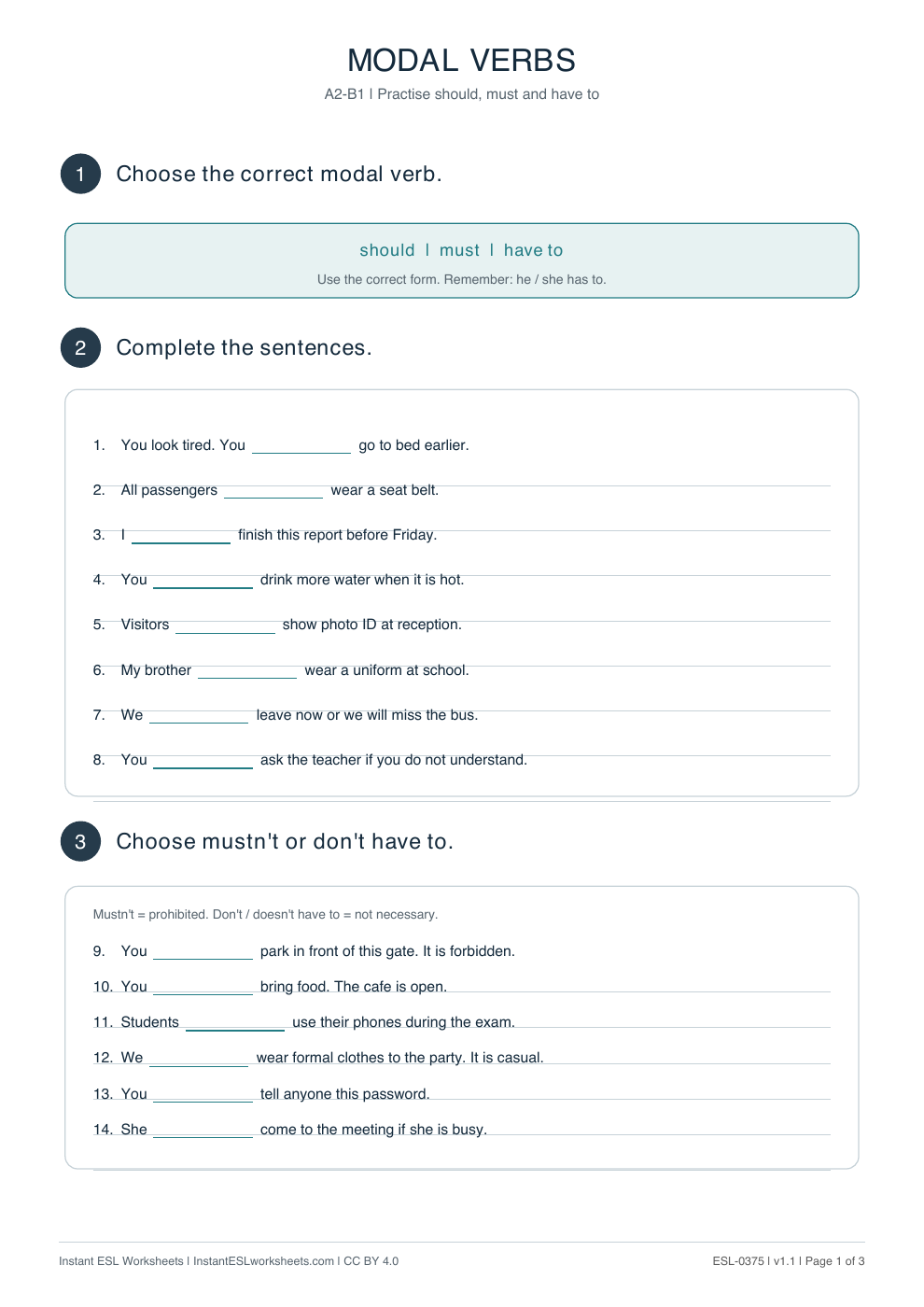
Modal-Verbs-Should-Must-and-Have-To
A clear printable reference guide to modal verbs: should, must and have to, with examples and helpful form notes.
What’s in the worksheet?
- Clear explanation of meaning and form
- Useful example sentences
- One-page classroom reference
- Suitable for independent review
Use this one-page reference to compare advice, strong necessity and outside requirements, especially prohibition versus lack of necessity.
Worksheet preview
Open PDF ↗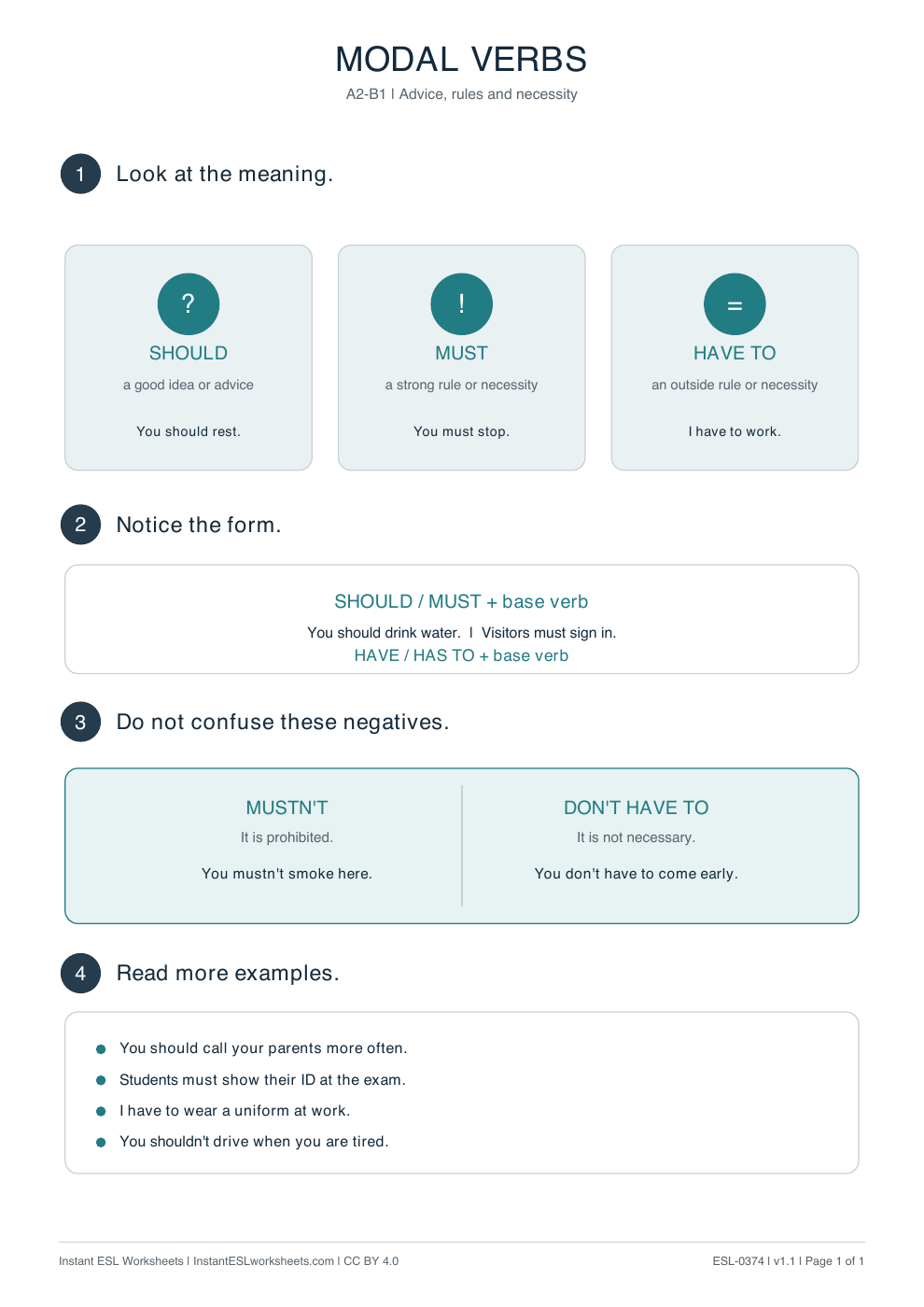
Page 1 of 1 · A4 printable PDF
A simple way to teach it
Before the lesson
Introduce a familiar classroom rule and a piece of advice. The sheet is an explanation resource, not a gap-fill task, and has no answer key.
- Compare You should rest, You must stop and I have to work, discussing the speaker's meaning rather than assigning every obligation one rigid category.
- Practise should / must + base verb and have / has to + base verb. Contrast You mustn't smoke here with You don't have to come early.
- Read the additional examples, then ask learners to explain one rule, one optional action and one piece of advice in their own words.
Support and extension
Support with prohibited / required / optional / advisable labels. Extend by changing a positive rule into both negative forms and explaining their different meanings; must and have to can overlap in real contexts.
Suggested approach. Adjust the pace and number of questions to suit your class.